What did you do?
I worked in USAID’s South and Central Asia office, supporting 4 countries over 3 years. Day-to-day, I was the go-between for our leaders at each US embassy and policy leaders in Washington. This meant everything from prepping leadership for meetings with heads of state to helping design new anti-corruption programs to serving as a surge expert on outbreak responses. I worked on four big things:
- Sri Lanka’s 2022 economic and food security crisis. USAID supported their entry into an IMF deal, surged fertilizer assistance to stave off a famine, and ultimately helped monitor free and fair elections.
- Opening a new USAID office in Maldives: most people in Maldives don’t benefit from the tourism sector, and the country has a large extremism/unemployment problem, plus the obvious climate change existential threat. We built really cool private sector partnerships to help all of the above.
- New global health security programming in the Kyrgyz Republic: I flew out to serve as health office director there last summer during a staffing gap. This was during a major measles outbreak, and before anyone there was talking about avian influenza. We were about to launch new lines of effort against drug-resistant tuberculosis, border disease surveillance, and laboratory strengthening.
- Most recently, I switched to Bangladesh to help support them as they built a new government from the ground up following their authoritarian leader fleeing the country last August. Immediate priorities were to keep their banking sector from collapsing, support anti-corruption reforms and domestic tax revenue collection, and help build the infrastructure for their first free and fair elections in decades this year.
How did you enter federal service?
I’m an infectious disease epidemiologist by training, working mostly in humanitarian contexts. Nearly every job I’ve had over my entire career, from parasitic disease eradication in Chad, to tracking the needs of people displaced by Boko Haram in Northeast Nigeria, has been funded in part by USAID or the CDC. I got pulled into USAID to work on COVID, when the Delta variant was killing hundreds of thousands of people in India. It took a year for my security clearance to come through, so I accidentally wound up working on broader issues. As a kid I was always really torn between careers in science and public policy, so was lucky to find a way to do both. I never left my home state growing up, so working in both globally was pretty beyond my imagination.
What was important to you about your work?
I was really proud of working to minimize hypocrisy in American foreign policy. That’s an impossible goal, but I really felt the work I was doing was the legwork. Walking the walk on helping governments be responsive to the needs of their people was really important to me. That’s a role only USAID could fill – no NGO operates on that scale. Also, the government-to-government level of operation was really important. I’ve been in meetings with heads of state where USAID was able to persuade them (along with our funding) to treat refugees in their countries humanely, or to hold local elections as scheduled. Not even Bill Gates can do that.
What should be important to Americans about the work you were doing?
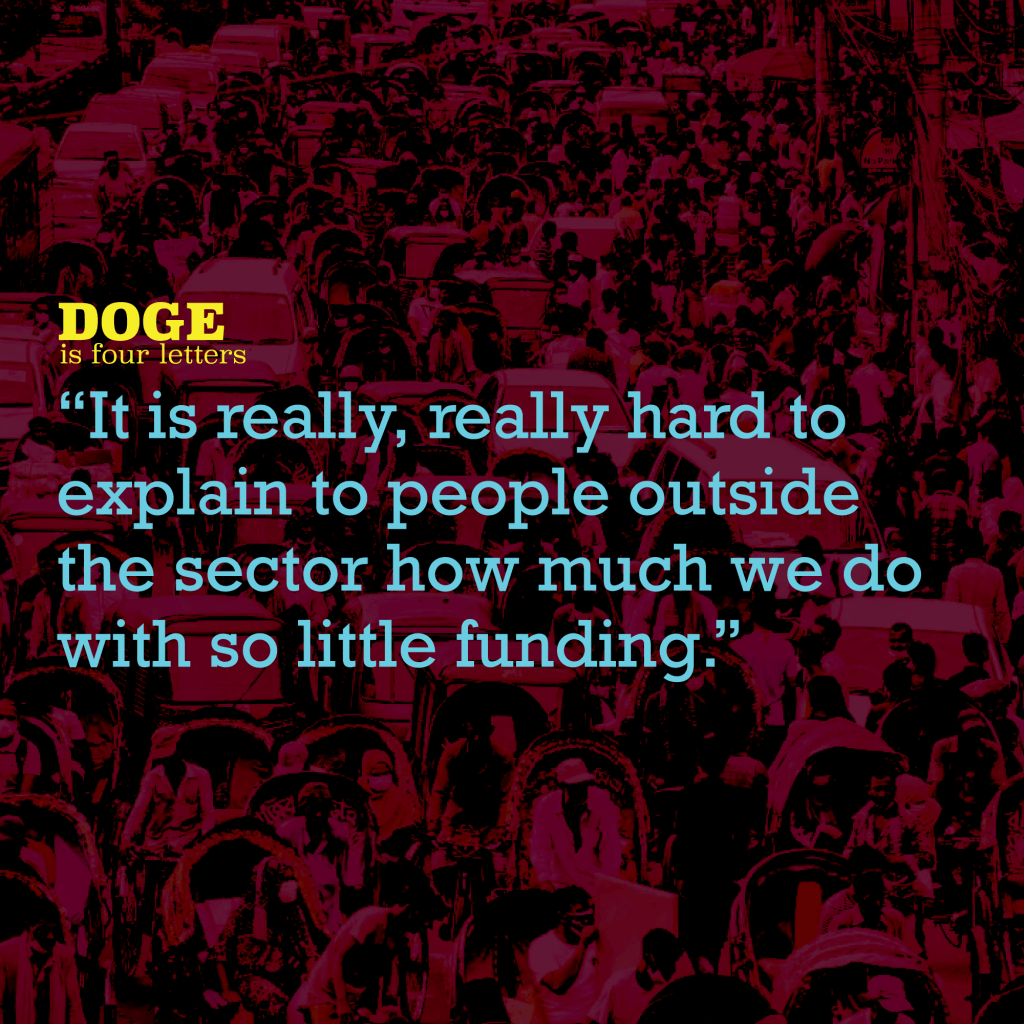
It is really, really hard to explain to people outside the sector how much we do with so little funding. US foreign assistance, especially through HIV treatment, provides over half the national health budgets of some countries in Africa. I think the speed and scale at which people start dying globally is going to be really shocking. I’m especially worried about drug-resistant tuberculosis skyrocketing. And at some point it will come home. This certaintly isn’t the most important impact, but I think Americans are going to be shocked at how travel is impacted by the shuttering of USAID alone. Anyone who dreams of going on safari, or backpacking in Asia, is going to wind up facing wild civic unrest and instability and, probably literally, people dying in the streets. For basically every global crisis that pops up over the next four years I’ll be able to point to something that USAID funded specifically working to prevent it. That much I’m certain about.
What’s next for you now?
Hah, well, two months ago my game plan was to spend these four years speedrunning a PhD. But with the simultaneous destruction of research funding & universities pausing admissions, that’s already a non-starter. I’m employable with transferable skills, went to fancy schools, blah blah blah but the work I want to do will almost entirely cease to exist. There is basically no private sector infrastructure for this stuff. For now I’ve managed to cobble together some contract work and paid writing. A retail side gig I used to have for fun will hopefully take me back with enough hours to cover health insurance. And after that? No idea.
USAID has local staff in every country we work in. These people include every type of expert you can think of, incredibly well-connected, just the absolute best and brightest around the world. Some of them have spent 20, 30 years working for America. Losing them – betraying them – was my biggest nightmare before the election, and now it’s happening.
Subscribe
For as long as it takes, GOLIKEHELLMACHINE will publish stories of federal workers, contractors, and others who’ve been impacted by the Trump Administration and DOGE’s cuts to the federal workforce. If you’d like to subscribe to GOLIKEHELLMACHINE and receive a weekly roundup of updates (instead of checking the site everyday), enter your email address in the field below and click the Subscribe button.
 GOLIKEHELLMACHINE