What do you do?
I am a supervisor at a federal agency that manages federal records. If you name an agency, we likely have records from them. Most federal records are required by law to be held onto for a certain period of time, or, sometimes, permanently. Most agencies don’t have the capacity to hold them so we do it for them.
How did you enter the service?
It basically started because I needed a job and I thought it would lead me to what I really wanted to do, which was to become an archivist. The pay I started at was awful, and I was on my feet for seven hours a day. I would tell myself that I just needed to get my year in so I could find another job within the same agency, but doing something much different. Seven years later, and I’m still working at the same location but have worked my way up to my current position.
What should be important to Americans about the work you do?
We help people get the benefits they are entitled to. Whether it’s a veteran accessing their benefits for the first time, or someone who has used the Indian Health Service and needs their medical records. Records are essential to government functioning. Not only do they help people get what they are entitled to, but also helps keep the government in check. If records aren’t properly maintained, the government can just pass off complaints saying there’s nothing to back it up from their end. Paper trails keeps the government and the politicians honest.
The facility I work out is roughly the size of 16 football fields, broken up into rooms the size of a small warehouse. Each room has a central aisle with rows of 15 foot shelves on either side. Records are stored in boxes, and we have a system that lets us track specific boxes to their exact location on a shelf. Sometimes, we then have to use the originating agency’s filing system to find a specific record within the box.
There’s one exception to this, which are IRS tax records, where we don’t know the exact location of the record, but can easily find it by using a numbering system established by the IRS. On a daily basis, we receive requests for records. Those records need to be pulled and then are either shipped, faxed, or digitally scanned. Records that are returned to us need to be refiled. Records that are scheduled to be destroyed need to be pulled off the shelf and shipped out. New records coming in need to be assigned a space and shelved. It’s a lot of physically demanding work. Some records don’t get touched for decades, until they need to be destroyed. But the government is required by law to keep them for a certain amount of time.
What does all of this chaos and dysfunction mean to you? Do you have a sense of how it’s all going to impact your work and your mission?
Financially speaking, I don’t make nearly as much as my friends in the private sector. One of the reasons I have stayed with the government is the Public Service Loan Forgiveness program. I also just do not see myself thriving in a corporate environment. In terms of mission, I truly believe that the current administration is trying to disrupt government functions to the point of collapse. I also think my agency is in the scope of the president, and the head of my agency and the senior level executives have already lost their jobs because of that.
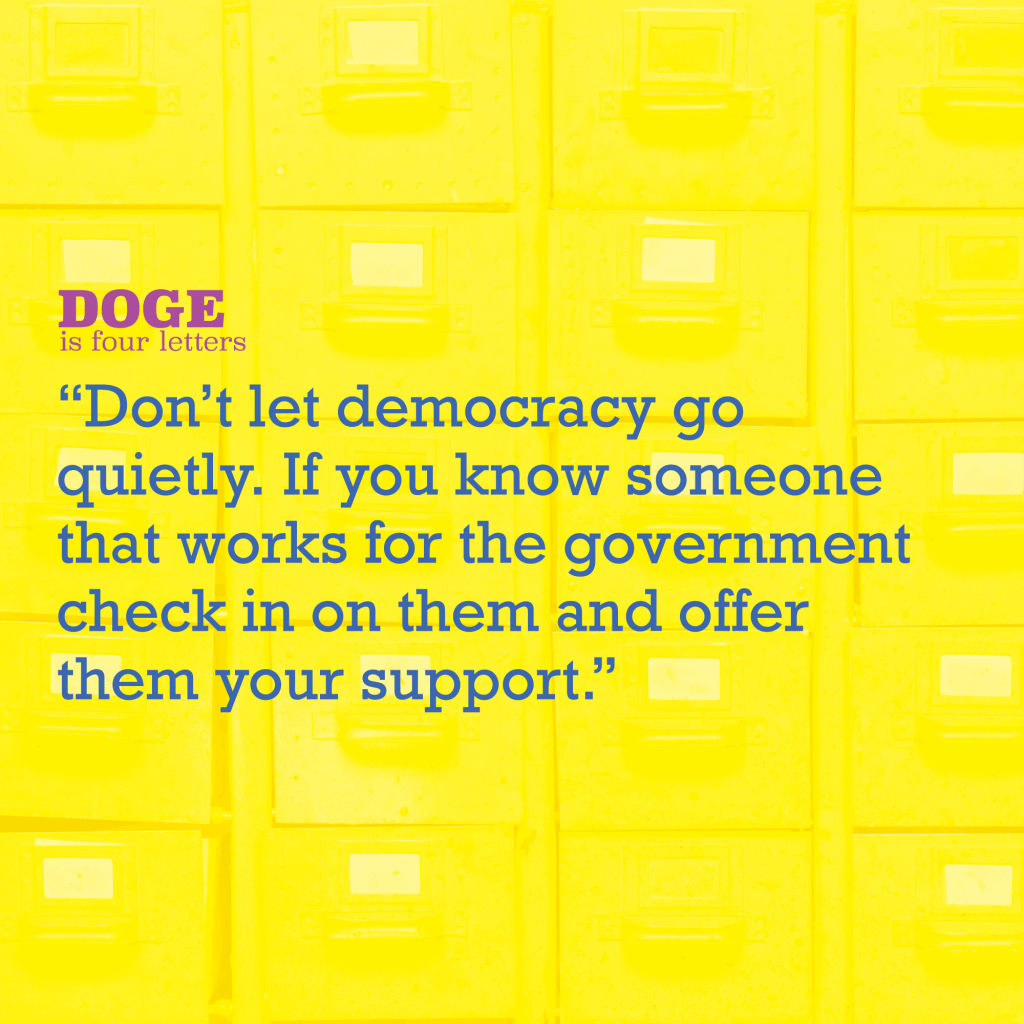
Call your representatives daily. The fate of the government as we know it rests on their shoulders. The administration has already done a lot of damage that will take years to reverse. Don’t let democracy go quietly. If you know someone that works for the government check in on them and offer them your support.
 GOLIKEHELLMACHINE