What did you do?
My job title was “Budget Analyst.” I worked at the National Oceanic and Atmospheric Administration in the Office of Habitat Conservation. I made the money happen for a near-billion-dollar coastal wetland restoration program called CWPRPA, or the Coastal Wetlands Planning, Protection, and Restoration Act, that shores up South Louisiana.
CWPPRA is a complex beast of a program – the U.S. Army Corps of Engineers and Louisiana’s Coastal Protection and Restoration Authority work together with each of 5 federal agencies to plan and execute coastal wetland restoration.
In my role, I prepared legal interagency agreements and routed them for approval. I made the funds available in our financial system so that they could be spent, either at NOAA or by grant to fund CPRA. The program is older than I am and has a multitude of records to match, so I also spent a lot of time untangling and reorganizing complex data that stretch back to 1990.
I wanted to leave the program better than I found it.
How did you find your way into federal service? Did you always want to join up?
I’ve always been in public service – I started out working in state government in Louisiana, and when I moved to DC, I found a contract job with the Office of Response and Restoration at NOAA. I worked as a contractor for several years, and, eventually, one of my OHC colleagues recruited me into my most recent position. I never wanted to work in the private sector, because something just made my skin crawl at the idea of my labor enriching someone else. I think it is a really noble mission to serve the American people and it’s in keeping with a long tradition of public service in my family. Civil service is all I’ve ever known, and it makes the prospect of being ejected into the private sector that much scarier.
My dad’s dad was in the Navy, and then became a schoolteacher, along with my grandma. My dad was in the Air Force. My mom’s dad was a state senator, and my mom is a lifelong community volunteer. Many aunts and uncles served in the military, work for the federal government, or did both. One of my sisters is a teacher and the other works for a city transit agency. There was simply no way I was going to do anything other than give back!
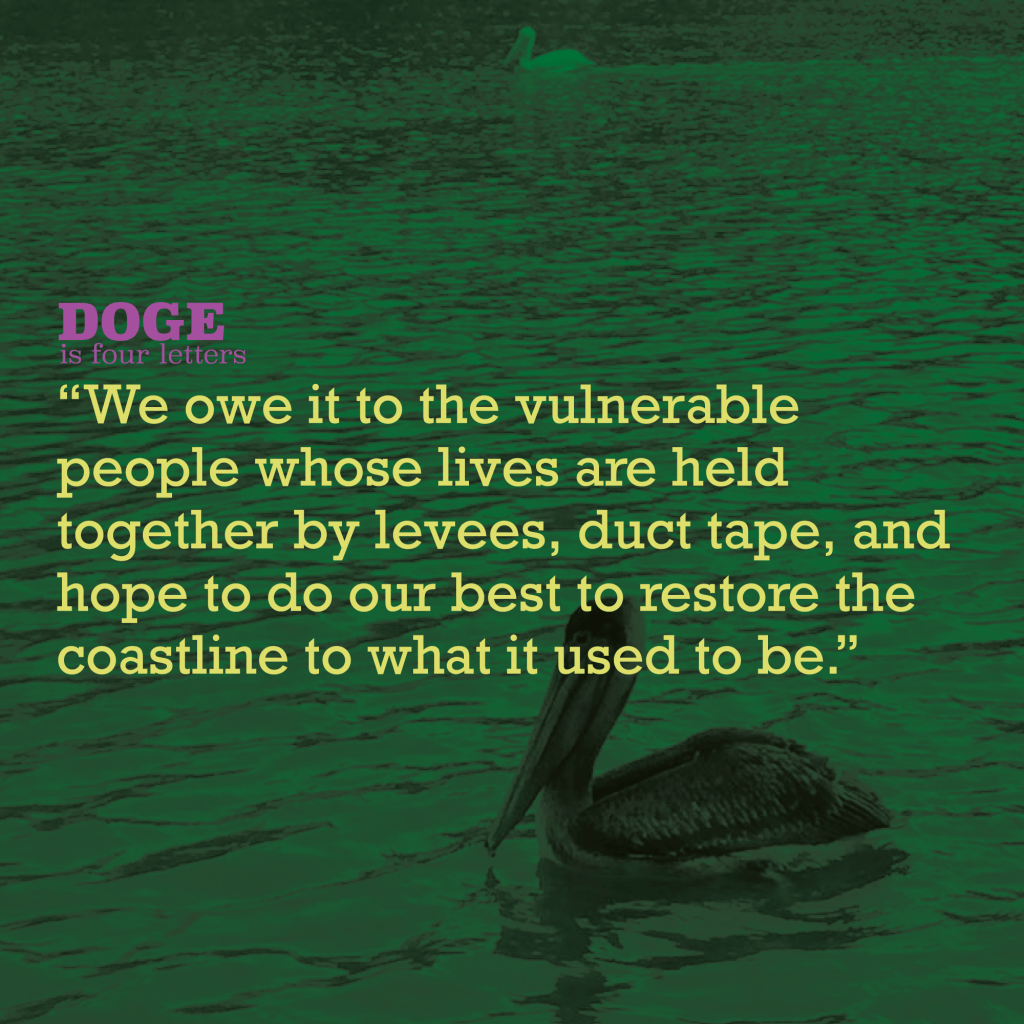
We owe it to the vulnerable people whose lives are held together by levees, duct tape, and hope to do our best to restore the coastline to what it used to be.
It was everything! I could have done budget work anywhere, but chose to do budget work at an agency with a mission I could take pride in. I grew up on the Gulf Coast in Florida, and went to college on the Gulf Coast in Louisiana, and I’ve lived through hurricanes, and have loved many people in my life who were impacted by Katrina, Rita, and all the storms yankees haven’t heard of. Without a strong coastline, there is no Louisiana, no New Orleans, no Mississippi River with a shipping industry the way we know it today.
What did this work mean to you? Why was it important to you, personally?
We owe it to the vulnerable people whose lives are held together by levees, duct tape, and hope to do our best to restore the coastline to what it used to be. A strong coastline protects them from hurricanes. It provides habitat for migratory birds. It allows the unnamed bayous that people know like the back of their hands to continue flourishing without the risk of saltwater intrusion.
A lot of people only see grandeur or majesty when they gaze upon a scenic vista off the side of the mountain, but I believe it takes a lot more patience and love and discernment to look out over a gray-green muddy swamp in the winter and see the beauty in it. It’s a one of a kind ecosystem that’s home to a one of a kind culture, and I was proud to every day try to help rehabilitate it little by little.
What should be important about this work to Americans? Why does it matter?
From a purely financial perspective, this program gives a crazy return on investment! Louisiana contributes $2.4 billion to the US seafood industry and 1 in every 70 jobs in Louisiana is in the seafood industry. You can’t have healthy fisheries without a healthy coastline. And when we protect Louisiana’s coastline, that dampens the impact of hurricanes coming ashore, so they don’t visit as much destruction on people’s homes — or on the massive amount of petrochemical industry in South Louisiana.
With a strong coastline, when a storm comes, those people and industries won’t need as much money from FEMA to build back what was lost, and we don’t run the risk of a massive oil or chemical spill from a damaged industry plant contaminating the area. From an environmental perspective, you’re protecting a rare and unique habitat of coastal wetlands that’s home to all sorts of birds, fish, bugs, grasses, and so on that aren’t found anywhere else. Wetlands are a massive carbon sink, so they’re critical to preserve if we care about slowing down climate change.
Finally, there’s the human perspective – small towns dot the entirety of the coast and those people deserve to live safe and protected lives, without worrying about whether the one road out of their town that runs along the levee will get washed away every time it rains. In this country we often say we’re “by the people, for the people,” and if you ask me, that means EVERYONE who lives in this country, not just the ones who live in places that aren’t slowly sinking into the Gulf of Mexico.
So, what do you do now?
Nothing yet. I was locked out of my NOAA email account on Thursday night but didn’t receive my termination letter until the following Monday. They couldn’t even terminate me right – my termination letter says that my occupation was “Research Biologist.” I’m applying for other financial jobs and thanking my lucky stars that I have a career that exists in both the public and private sectors.
 GOLIKEHELLMACHINE