
I work at the public library. I don’t have a library degree, so I don’t call myself a librarian. It’s kind of controversial in the industry. People with an MLS, a Master’s in Library Science, you know, sometimes they push back against, like, de-professionalizing the industry. I fell into library work accidentally. I’ve worked at a lot of really small nonprofits. I’m functionally an IT guy — I’ve always been an IT guy with an art degree, and when I finally got to libraries, I realized I could touch everything and do everything.
I’ve worked at this library for 9 years. It’s the only library I’ve ever worked at, so I’ve been in libraries for 9 years. Every other job I had before that was maybe 18 months. I worked in a tech services department in college for 2 years. So, yeah, 18 months, 18 months, 18 months, 18 months, 9 years.
I was a super lazy student. I was one of those people that never turned in my homework, I would do a lazy job on my papers, I aced the standardized tests and I would get a B-. I left high school with a 3.2 GPA. I learned exactly what I wanted to learn, and ignored everything else, and art was always the thing I was naturally good at. I liked to write as a kid, I wrote stories, and I love to draw. I love to play with clay, like, I loved to make little clay figurines and stuff. Everyone was like, “You’re an artist!” my whole life, and I was in a real cruise control mode going out of high school, so I decided to do what I was already good at and not open myself to any new experiences. But they opened for me, anyway, because I wanted to go into graphic design in the art program, and they only accepted 36 students. It was very popular, and I didn’t get in. I didn’t have a great portfolio, because I was a lazy high schooler.
So then I was like, okay, I’ll do industrial design, I couldn’t get into that, for the same reasons. I was so fixated on, like, “You have to do something that you can do for work”. I’ve always worked. I got my work permit when I was 14, and I’ve worked nonstop since then. I took a 3 month break once, but otherwise it’s been job after job after job after job, part-time when I was in high school and college, and then full-time any time I wasn’t in school. So, I’ve always had jobs, I have had a million weird jobs. I’ve worked at a self storage place, I worked at a sub shop, I ran the second video camera on a public access television show. All these little weird jobs just didn’t light a fire in me to have any career that I wasn’t already good at.
I went to a School of Fine and Applied Arts, and I couldn’t get into Applied Arts, and I was like, “Oh no, who goes to school for painting?” I had a scholarship, too, so I didn’t feel a lot of pressure, necessarily. I was like, “I guess I could major in fine arts, but I can’t get a job doing that. But I’m good at getting jobs! Maybe I’ll enjoy it?”, and I really, really did. Doing group critique was incredibly important, one of the most important things I did in my life, as far as setting me up for a career, making me a resilient worker and person, because I had to get over that this guy was criticizing this thing that I made. How dare he? It’s not that he doesn’t like it, it’s not that he doesn’t like me, I have to take the feedback, and I have to put it back into the work. If your professor tells you to do something, you should strongly consider doing it, and that was really good for me, because I am very individualistic, very sensitive and very anxious. I was like, “I am getting this feedback, and going to take it, I have to internalize it and then I have to put it into the next version of this work”, and having to do that 3 times a week was huge for making me a more well-rounded person.
They always give the art students the worst building on campus, because pouring the paint down the sink would ruin the plumbing. They would always give you something that was 1 year away from demolition, so I would stalk back to my studio and be like, “You’re telling me to do this!? You’re telling me, an undergrad art student, how to make my art?!?” But it becomes like a muscle. This is really silly, but I remember they were critiquing something of mine that had bilateral symmetry, and they were like “In many cultures, bilateral symmetry has a certain… you know, it looks like it has a gynecological quality to it”. I remember being in such a huff of like, “It’s not fair! That’s not what I meant! I’m not trying to do that! Do I have to take the bilateral symmetry out of this work so people don’t think that about it?”, and then I stewed over it, and I finally did it, and then, lo and behold, I took it to the next critique, and people understood what I was trying to say because it was no longer so strongly bilaterally symmetrical. That became a muscle.
I had websites as a kid, like, I’m part of the Angelfire, GeoCities generation of people who learned HTML so they could put falling snowflakes on their page with their Webring buddies. We had a computer in 1996, we got a Gateway 2000. I took a keen interest in the internet, and I think my parents were kind of like, “We don’t know if that’s normal or not, so, you know, don’t look at anything illegal”. Neither of them were super techie, but my mom was a librarian, and so she was the one who said that the kids should have a computer. She’s a college librarian and she had a stipend from her college for a family computer, so she’s the one that brought the computer home. I have a vivid memory of her pulling up the Gopher site of a Swedish library and saying “We’re inside a computer in Sweden right now!” and I remember being like, well, “This is what you gotta do. You’ve got to be on the computer”. Whatever creative or artistic endeavor I was interested in, there seemed to always be a computer component, and I would figure it out because I wanted falling snowflakes. By the time I was 18 and leaving for college, I was sort of like, “whatever I’m going to do, it’s going to be on the computer, I kind of like it”.
My only nepo baby job was that my mom got me hired at the community college computer lab. That was really formative — like, being the most junior person in the IT department. You’re there after hours, pushing a cart around, Norton ghosting in a computer lab. I absorb things fast in a trivia way, so I just built and built and built on what I learned, but I can’t count. I have what I think is dyscalculia, like, I cannot count, I cannot do math. I’m at remedial level with math, and that was a big reason no one ever encouraged me to go into tech as a major or as a career. Computer science was totally off the table. I kept having hands’-on IT experiences, and each one built on another one.
I would go in and out of the industry. I worked in a t-shirt shop for a while. For a while I was like, “I need to work in a factory. I’m sick of educating myself”. It was a really good perspective, working in a factory and realizing how tired your feet get. I remember being like, “Okay, maybe not 100% factory work, because my feet hurt more than they’ve ever hurt in my life”. I’m glad I had that experience early. I had a work-study web design job at a really small web design company. I just kept collecting little bits of technical knowledge with almost no formal training at all. I’m totally taught on the job. I remember some vendor sitting down and explaining Microsoft Group Policy to me. He didn’t have to do that — he was dropping off a piece of equipment.
I was always, like, the office manager for a bunch of 20-person nonprofits. When you’re at a 20-person nonprofit, you can gently just tell them what you’re going to do, because they’re paying vendors, they’re leaving stuff on the table, they say “We don’t do that. It’s too much messing around”. Whatever it is — they don’t publish their newsletter, their routers all have different names. They don’t have custom email newsletter templates. It’s all a bunch of stuff they give to a vendor. Their vendors are kind of slow and don’t like them very much, because they’re a small client. You can just start going in there and bushwhacking through systems and say, like, “Let’s simplify this one”, “Let’s upgrade this one”, “Let’s print this in full color”. You have to earn trust, but I earn trust pretty fast. In my electronics job, I would say “All I’m doing is reading the manual faster than the customer”. People would call, and they’d be like, “Excuse me, I need to know what the minimum operating temperature of this thing is?”. I would Google it, look through the PDF faster than they did, and I’d be like, “Oh, of course, it’s -20 Celsius”, and they’d be like, “Thank you so much!”. I don’t know it, I just know where to find it for you. That’s how it’s been for a lot of things. That’s how I taught myself. I don’t know how to use InDesign, I just know that I want this to look cool.
Any time I could, I’ve tried to make it about 50% art and 50% technology, and I need both, because each is a release valve for the other. As an IT person, nobody questions you, right? You’re constantly power tripping. You’re constantly getting to be like, “It just works like that”, and people go, “Oh, that sounds so true”. I go back and forth on sexism in the industry, but as a young woman, I loved being like, “We need this to be in a high availability configuration”, and people are like, “Yes, of course you can have $1,200”. That’s very important for me, it was a memorable incident where I realized people were just going to listen to me. It’s important for my ego. But it’s hard, I’m often pushing the limits of my ability and my creativity, too. I’ll get stuck on stuff and be like, “I shouldn’t have done this, they’re going to find out I’m a fraud. I’m a failure and they’re going to figure out I’m a fraud!”.
Art, of course, everyone has an opinion. Nobody listens to artists. Everyone goes, “I don’t like lavender. I don’t think it’s good. I can’t explain why. I just don’t like it.” People don’t have any idea why they don’t like things, they just know they don’t. Have you ever seen the movie The September Issue? It’s really cool. It’s about preparing an issue of Vogue, the September issue, which is their big issue. They show the whole process of making these beautiful photographic editorial spreads, they send people to Versailles and they take all these pictures. There’s a famous photographer and famous models and the famous façade and there’s lighting, and then they show the photos coming back to the office, and they’ve got people painstakingly color correcting, and they show a guy laying it out how it’s going to look in the magazine. They put these spreads on big tables in front of Anna Wintour, she’s the brand, right? She doesn’t have time to give feedback. She goes around and just pushes the one she didn’t want off the table. That’s how it feels sometimes. When I feel a little too put upon as an artist, I’m going to go and image some computers. They won’t tell me something doesn’t look great.
I got super lucky. I arrived at this little town kind of on a whim. It’s a rural area, and there’s a chain of rural towns. We were renting and working in a college town, and wanted to move to one of those rural, scenic mountain towns, it didn’t matter which one. I didn’t have a job, but I felt like, you know, I moved to Colorado with no job and moved to Minnesota with no job, and I felt pretty confident that I could find something, so I quit my education electronics company job. When I started looking, I was like, “What kind of jobs are in this little town?” and I checked library jobs because my mom is a librarian. I noticed they had 1 position open for the exact kind of job I’d been doing since I graduated from college, it was a tiny IT department job plus office management. There was no art quality to it at all… except at the interview, they said, “We’re thinking about putting in a makerspace”, and I had worked at an educational electronics company, and before that, a kids science and engineering museum, so it was like, “Not only am I an IT guy, but this makerspace thing, I can help you with that. I’m also an artist and an illustrator”. Sometimes, you have to wait on telling them that, because it sounds like you’re going to be really head-in-the-clouds. Every single job I’ve had, I’ve had to prove the art and design thing quietly.
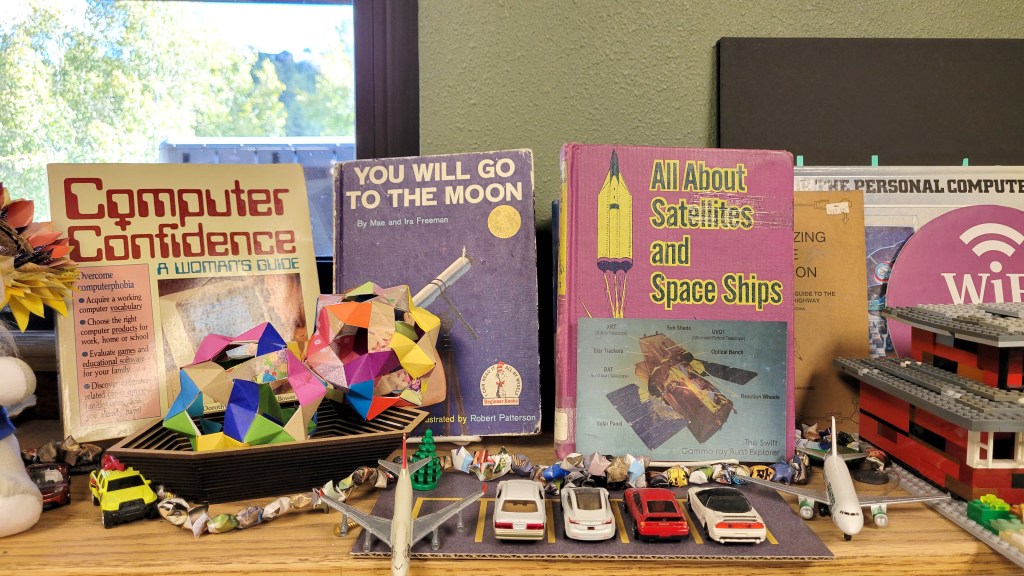
We do a different theme almost every month. We’re starting to reuse themes, but we’ve gotten into a habit. They always want to make the library look welcoming. They always want people to see what’s new. Me and the marketeer, the communications person, have gotten the library on a schedule of changing all the collateral every month. We used to do it quarterly because we had a quarterly printed newsletter, so it started as a newsletter cover. And then I would be like, “The newsletter is coming out, oops, I just slipped and I made a really beautiful cover for it and it’s all original illustration”. It started as a newsletter cover, and then we turned it into this monthly thing. August is ‘School of Life’ month, and the posters we put up around the library look like composition notebooks with doodles all over them. That gives me up to 12 opportunities every year to do custom graphics, and we reuse a lot of them, but that’s where a lot of my illustration work goes. I make t-shirts, I just made tote bags for the volunteers that have a really sumptuous illustration on them. They would be content with less, but our marketing person, she says that the original illustrations make her job easy. She really sees the value of it. So we keep doing it. Once in a while, I try to pull out the stops and do something that’s more handicraft-ish. I’m cutting some old paperbacks into a fall pumpkin. Here’s your pumpkin vine, an old phone cord. My pumpkin leaves are magazine pages.

We’ve had a makerspace at my library since 2018. It’s a downtown library, it’s really cool. There’s only 1 branch, which is unusual. We’re a library district, so we’re tax funded just for our library. Gives us a ton of autonomy. Many libraries are huge systems with multiple branches, and the branches report to a main library, they’re in all different parts of the city, they have different needs and challenges, all of their buildings are different. We get to make decisions based on our staff capacity and what our community wants. The makerspace is a big square meeting room with cabinetry, and we’ve slowly gotten equipment in there, though I’m not in charge of it anymore. I helped kick it off, and they did eventually decide they needed a full time staff member who does the class programming. We’ve got 3D printers, we’ve got a laser cutter that’s constantly booked, we have an industrial sewing machine, we have tons of hand tools, we have a lot of scrapbooking-type crafting tools. There’s an automatic embroidery machine that’s really popular. There’s a laser cutter that can do engraving, that one’s cool, I use it all the time. I used it in my work today, I was engraving leather notebooks for departing trustees.
My hope is that makerspaces and libraries that by the time I’m retired, a makerspace will become a kind of library branch, because the other makerspaces are, what, $60 a month, usually? From a library philosophy standpoint, I think there are a lot of parts of this that libraries are really good at. How do you make everyone share without breaking too many of the things, and make sure that we’re all part of the community? How do we make sure it’s free for people who can’t afford it, or make it free for everybody? Libraries think about this all the time, along with how to manage public spaces, including public spaces that are tempting to misuse in whatever way. I would love to see these things more formally join forces, like, a makerspace is also a library, and a library can also be a makerspace.
Colorado Springs has an amazing, mall-sized library and makerspace. They’re a big system and they prioritize it. I think a lot of places could go that way. I’d love it if spaces like that became more accessible via libraries and libraries became more, you know, like, more dangerous. I’m just so tantalized by the implications.
My library would like me to go into management after 9 years of being the little IT dude, the all-purpose jack of all trades. They were like, “What if you were a manager?” I don’t want to, I really like to be very hands’ on. I like doing project lead type stuff. But I have laid the seeds of, like, “But if you ever spin this makerspace off into a branch…”, and probably the only thing that would seriously tempt me to leave is if I could run a library makerspace branch. We have a tool lending library, and I’m in charge of the committee. So that’s one of my weird little roles. That’s the part that I really get capital-L Librarian about and have a lot of philosophical perspectives on. I just got back from a conference where I spoke about it. I love the library of things. I love the tool library concept. I really enjoy that. It’s probably 4 hours of my week, but I love getting really philosophical about, like, “How do you lend someone a sewing machine? How do you lend them a stand mixer? How can we all, as a community, share a stand mixer?” It’s a really fun, small, energizing part of the job. I’m really proud of the library of things, and all of the things we can lend, and of the makerspace. But I’m also jealous of all the other makerspaces.
I’m not suited for some other jobs, for a bunch of different reasons. I have to be honest, this job doesn’t pay that well. There’s that great tweet that was like, “The ideal job would be 4 hours of programming in the morning and 4 hours of loading boxes on a truck in the afternoon”, and I was like, “Oh, that’s my job!”. It’s wonderful, and it’s very important to me, and I really need it. But it pays more like loading a truck. My mom often is like, “You’ve got a perfect job that you built, and you made it in your image”. I still complain, I’ll come home and complain all the time. But I’ve been lucky to make it in my image. I’m lucky that it’s the right size, and that I can contribute the way I want to. I’m tremendously, tremendously lucky, you know?
 GOLIKEHELLMACHINE