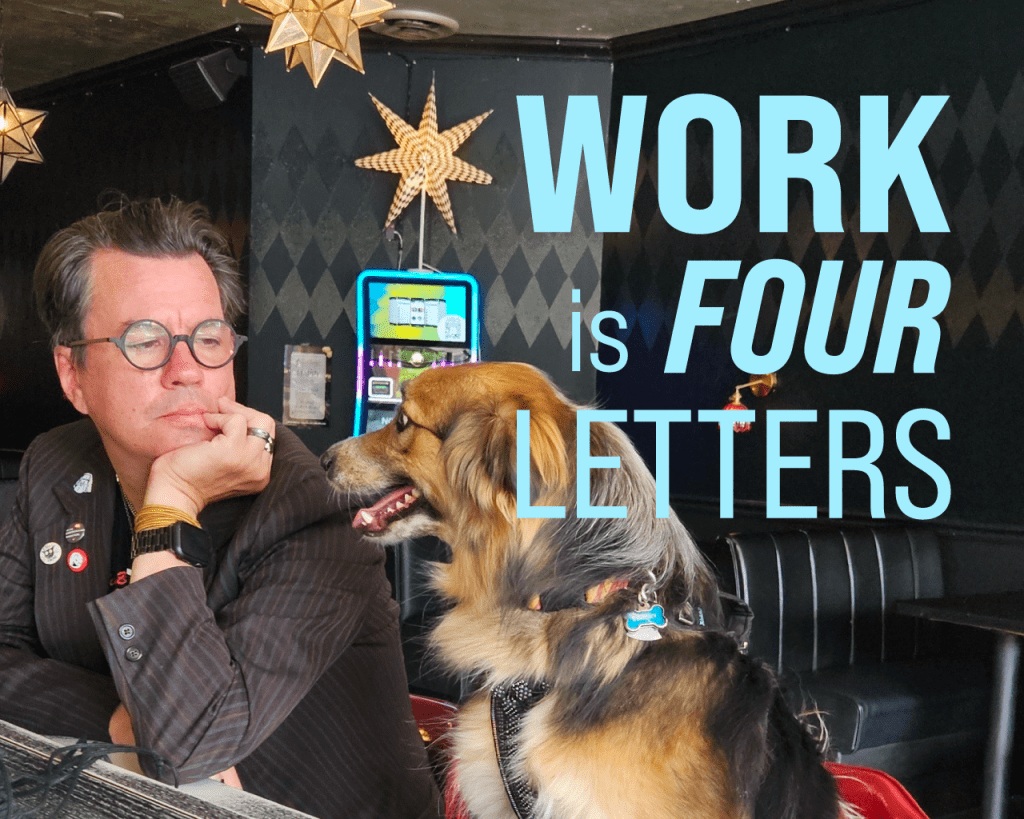
Name: Karl Christian Krumpholz
Location: Denver, CO
I’m a cartoonist and an illustrator. I’ve been doing artwork for about 30 years. Back in the day, in the 90s when I started, I was doing very primitive zine-type comics since I really had no idea what I was doing, and you kind of have to just go through and figure it all out. But professionally, I’ve probably been doing it for almost ten years as an illustrator and cartoonist. This is now my day job, rather than doing it on the side.
What actually got me into the comic book industry, or, I should say, what got me my start doing comics back in the mid-to-late 90s was when I was working at a comic shop in Philadelphia and — you know, I’m all around comics and always talked about doing my own comic. What happened was, there was a woman, I’m trying to remember her name… Patty Breen. She was doing a comic called Kiss and Tell, which started off locally and eventually got picked up by Sirius Publishing, but this was back when I met her and it was still a local comic. She said to me, “If you want to do comics, do one page and I’ll publish it in my book”. So that first page I did was a backup feature to her comic. It was gawdawful. This had to have been, ‘97, ‘98, and that was my first comic page. That’s what started it all. I soon started doing my little comic called Angst Boy Comics, self-published zine, going to Kinko’s, printing everything out, and it all kind of went from there. It was basically a fictionalized account of my own life. It’s slightly autobiographical, but in a fictional setting.
I went to Temple University in Philadelphia. I was a RTF major, which is Radio, Television, Film. When I was going there, the joke on campus was that it actually stood for “Rather Than Fail”. I was a RTF major with a history minor and kind of just fell into photography while I was going there, started taking photography courses and I found it a lot more fascinating than all the radio, television and film classes I was taking. So I tried to move over to Tyler, which is Temple University’s art school. I was told that if I wanted to move to Tyler, I could do that, but I would start off as a freshman again, which I wasn’t about to do. So, yeah, I just basically took all the photography courses that I could take with the idea of becoming a photographer. It’s funny because, in the last year, I reconnected with a woman that I knew back in the day when I was a student, and she was surprised I was a cartoonist. She was like, “You’re a photographer”. I was like, “Oh, I fell into cartooning”.
The idea of, like, how to set up a shot? It’s like a crossover as a lot of cartoonists go into storyboarding. I mean, it’s the same idea. My photography started off in journalism classes, where the big thing with journalism photography is a full frame shot. Everything is in frame, there’s no editing, there’s no cropping, put everything in that little box. I slowly moved from journalism photography — because I took all the journalism photography classes — into art photography. I mean, all that certainly helped my cartooning work. Every now and then, I still do storyboarding for commercials. Which is, I mean, that’s fun, and it’s a different way of looking at things, right?
I always grew up around art because my uncle was a painter and, of course, looking back now, being a little kid and seeing my uncle do these works, these big canvases… they weren’t even canvases, he was painting on wooden boards, but big pieces. I remember a large influence on me being a little kid and going to the Annenberg School, which is part of University of Pennsylvania. My uncle had this huge art show, all his pieces on the wall. Looking back now with all the years behind it, like, he was a bit of a failed artist. I mean, this is what he was doing on the side in the 70s and 80s. You know, he was sending out, like we all do, sending out letters, as there was no email. He was sending out letters to publishers about his artwork. Once he passed in 2018, I was the one going through all his archives and found all the rejection letters that he got, and he eventually stopped doing it, which I find heartbreaking. But he did influence me, and this is the art world as it is. It’s always going to be a struggle. It always seems that you’re getting through it all by the seat of your pants. My mom calls it a family curse because it was her brother that was the artist, and then I fell into it, and now my niece is — she’s, I think, 13, 14 years old — and she wants to become an artist. So my mom laments the art gene of our family. I tell my niece it’s not easy. It’s always going to be a struggle, a struggle that can be worth it all.
If I was still living in Boston, I don’t think I would be able to get by as an artist, because Boston’s so wicked expensive. I get by now for two reasons: Denver is slightly cheaper, and my wife has a great paying job, you know? Which helps when my work is light. Denver is also such a small community, over the last 10 years, I’ve been able to make a name for myself with my work, so people know who I am. It’s funny — going into bars and people who have never met me or Kelly recognize us from the comics. The amount of times Kelly’s outside smoking a cigarette and some strange person approaches her and says “I know you, right?”
I’ve been doing artwork officially since about the end of ‘15, beginning of ‘16. What happened was, I was doing some illustration gigs, but then Noah Van Sciver, who is an indie cartoonist I’ve known for years, announced that he was leaving Colorado and moving up to Vermont to a cartoonist school up there. At the time, he was doing a weekly comic for the Denver’s Westword newspaper. I don’t know how many indie newspapers are still even around — I know the Boston papers are all gone, and I know the Philly papers are all gone, but the Westword is still holding on because of weed advertising money. Noah was doing a comic for their music page, and when he was leaving, they asked, “Who do you think should take over your comic?” and he suggested me. I still don’t know if that was a blessing or a curse. So, I did a weekly comic for the Westword from the end of ‘15 until early 2020, when the lockdowns happened. For the first half of those years, I was doing the history of various music venues in Denver, because the comic appeared on the music page and needed to be music related. After about two and a half years, I was running out of venues to do histories about, so I started doing band stories, little short stories that could be told in three or four panels about weird things that happened to a local band. Of course, that all got shut down when COVID happened because the music venues weren’t open, there were no shows going on, so there was no revenue coming in.
The music page shut down, my comic shut down. When things started opening again, the Westword asked me if I wanted to revive my weekly comic, and I said “No”, because it was a lot of work for very little return. But I started doing features for them every couple of months about Denver history, because I was more into the history — especially since Denver’s not my city, it’s my wife’s city. It’s Kelly’s city. This is a way for me to learn about this place, and those original Denver music venue comics became the backbone of my Queen City book.

When I moved to Denver, I was working for Pearson Education as an editor of textbooks. I did that for a couple of years, but since I was working in Denver and Pearson didn’t have an office here, they could only keep me for, I think it was two years. My boss at the time basically said to me, “Do you want to move to Indianapolis?”, and I said, “Fuck No”. So with that gone I started picking up freelance gigs from my old contacts in publishing for a couple of years. Then I did survey work. Again, just kinda falling into it. I traveled around the U.S., mostly barren parts of the country, and set up LiDAR equipment that would scan power lines. It wasn’t steady work. The first time I was out on the road for three months and then six months of nothing. Suddenly, they call you up going, “Hey, we need you on the road for another week or two”.
Idaho tried to kill me twice. This was in 2009, I was out in the area around Coeur d’Alene. It was me and another American, the guy who got me the job, Rip, and about three or four other employees who were all English, because this was a British company I was working for. I didn’t know Coeur d’Alene was the white supremacist capitol of America, and this was around the time Obama got elected, so I saw a lot of Confederate flags and a lot of anti-Obama stuff while I was up there. We were leaving Coeur d’Alene in late November, around Thanksgiving. The guy’s like, “Okay, pack up everything in your car, we’ll do the jobs, all the scanning stuff that we need to do in Idaho, and we’ll all meet later tonight in Missoula, Montana”.
They sent me up to the top of a mountain in Idaho to set up my LiDAR. I was in a corner of the woods and a lot of trucks were passing me with all these guys with guns and orange vests as they were all out hunting, and when I got the all-clear to head to Missoula, I headed down the mountain. This was before smartphones — we had GPS devices in the rental cars to guide us. It was telling me to go down the mountain and go east, deeper into a forest road between the mountains. I drove maybe three or four miles and it was around 7PM, but I was in the middle of the mountains on a ravine road, so it was pitch black out. As I was driving, every time I turned, the car acted funny, and after about three or four turns, I realized, “Oh, I’ve got a flat tire”. I got out of my car and… you know, while I have a driver’s license, I have never owned a car. I kind of know how to change a tire. I was thinking, “Okay, I can work my way through, pump the car up, take the lug nuts off, put the tire on”. I pulled everything out of the car to change the tire, and while I did have a replacement donut tire in the rental, there were no tools to actually change the tire. After a lot of cursing, I remembered a ways back, I passed a hunter’s lodge, a bar, in the middle of the mountains.
I drove with a flat tire back to the bar and by the time I got there, the rubber was gone and the tire was in tatters. I was in my Red Sox cap and a leather jacket walking into this Idaho hunters’ bar trying to downplay my accent and I was like, “Hey, I got a flat tire and my car doesn’t have any gear to fix it. Could I possibly get gear, the thing to jack up the thing?” I didn’t have the winch. The bartender, he looked like beef jerky with this long fucking beard. He was wicked thin and wearing a Seattle Seahawks cap asked, “What the hell are you doing in the mountains without a way to repair your car?” And I just replied, “It’s a rental. It’s a rental!”. In the end, the guy said, “Hey, I’ve got a truck out there, you can use the truck jack”. I got the car up. But the rubber was all in tatters since I’d been riding on the rim for a little bit, so it was kinda fused to the car. I got the lug nuts off but couldn’t get the rim off. I had to go back into the bar, and they gave me some WD40 and a big maul hammer. I had to spray down the rim and slam it a couple of times with the maul hammer until it popped and skittered off in the snow. I got the donut tire on, got all the lug nuts on, went back in, gave them the maul hammer, bought the guy a drink who lent me the tools and just sat there and the bartender’s like, “Do you need a beer?”, and I was like, “Fuck yeah, I need a beer”.
After about 20 minutes, I’m thinking, okay, I gotta get out of here. And I said to the guy, “Listen, I gotta get to Missoula and my GPS is sending me further down the ravine…” He looked at me and said, “Don’t trust those things. It’s sending you down hunter trails to get over the mountains. Don’t do that. Go out to the highway, go around the mountains, take the long way. It’s much safer.” So I finally got down to the highway, taking the long way around.
All during this, I’m out of cell phone range. My phone was dead. Dead, dead, dead. I crossed over the Montana border, and I had to pull off the highway to get gas. This had to be around 10PM. My phone exploded because I was suddenly in cell phone range again with all these messages from the other surveyors going “Where the fuck are you?!”. I finally called them and they were all drunk at the hotel bar because they couldn’t do anything but wait for new info. And they’re like, “Oh, thank God you’re alive. You better call your girlfriend.”
That was the first time that Idaho tried to kill me, and a month or two later I had to go back so Idaho could try to kill me again. I flew in from a helicopter from Portland to Spokane, where another rental car was waiting for me. It was one of those cars where it’s got the chip in the key. So I drove out to my location, which was in a small town, set up my GPS, blah, blah, blah. When you’re doing the GPS you also have to do ground surveying of the area. So I was doing that while I’m waiting for the helicopter to go by. When I finally got the all clear, a couple hours later, I went to pack everything up and I realized I didn’t have the car keys. Apparently, when I was pulling out my gloves, I lost the car keys at some point and it’s not a thing where I could get AAA help because it’s got the chip. It took me an hour or two to retrace my steps and find my car keys in the snow.
During that, in my panic, I slipped on the ice, hit the ground. My leg just went right under me and I really fucked up my knee at the time. And I was just thinking, I was like, “I could have an accounting job, you know, this is bullshit”. That was the second time Idaho tried to kill me, and I’ve never been back since, thank fuck.
Then I started working for Graphic.ly in the early teens which lasted maybe 3 years. Graphic.ly had tried to be a comic book and social media startup. They were trying to compete with Comixology, and it just didn’t work. I mean, the whole business collapsed, right? I got let go from them in 2013 – 2014, and did more freelance work until I started doing the comic stuff full time.
I’m usually juggling several different projects at the same time. It could be my own projects, like In the City or work for the Westword. Right now I’m juggling 3 different jobs, all comic book work, which is great! This week, I got a script from a magazine that asked for a 2-page comic. I’m not writing it, just drawing it. Yesterday, I spent the day drawing both pages. Today, I spent the day inking, scanning them in and getting them ready for coloring, which I’ll do tomorrow. Every morning, I have an idea of what needs to get done for that particular day. It’s not like at 9AM, I’m like, “Oh, what am I going to do today?” That’s never the case. I usually know all the things I need to get done. I just finished the latest issue of In the City. I’m getting a proof made, reviewing, and sending it out. I’m doing an event on Thursday here in Denver, which is less of a comic event, it’s more illustrations — it’s for the Colfax BID [Business Improvement District] that I’ve done some work for, so I am getting prints ready for that event, so I have something to sell. It’s a lot of juggling various projects and keeping a lot of balls in the air.
[Being an artist] means a lot of things. It’s the idea of creating something new that no one’s ever seen before and getting your own particular view of the world out there. I want to create something no one’s ever seen before. I want people to enjoy it. This is my view of the world. That’s the base gut thing you want to do. But for me, a deeper thing is, because of my background, I love and want to talk about history, but you can’t preserve everything.
This is a little way of preserving it. My Queen City book was an example of this, the idea of, “Okay, I want to understand Denver since I didn’t grow up here”, you know, since I’m an East Coaster.
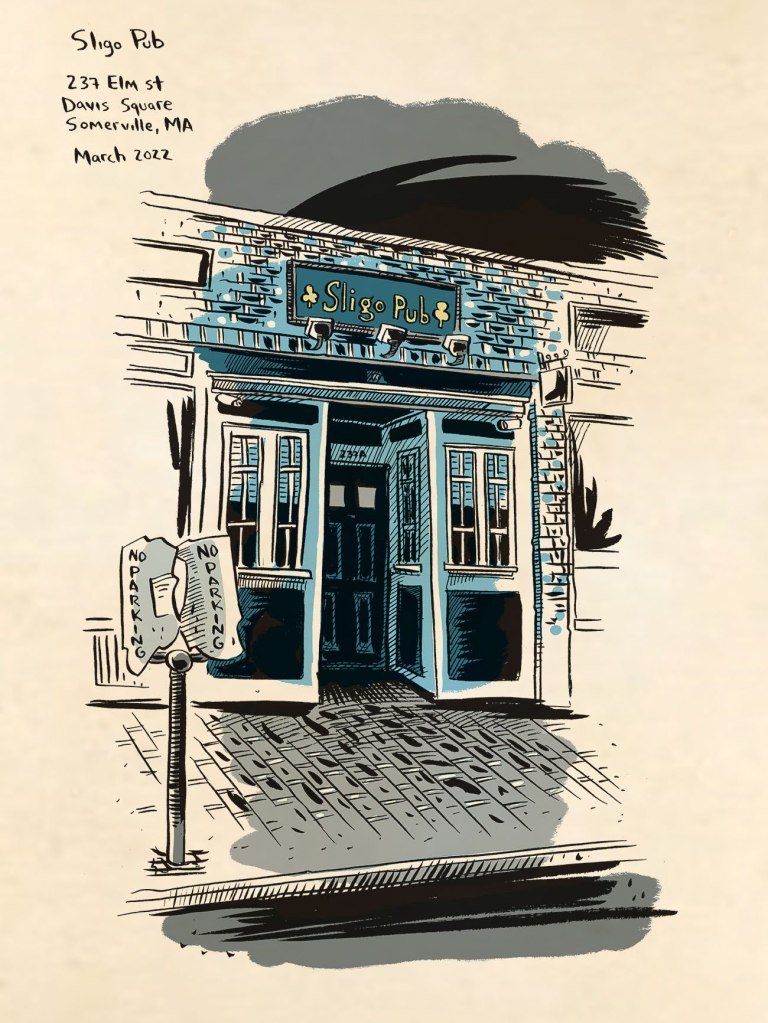
I still feel like a tourist in the city that I have lived in for well over a decade. The idea of Queen City was this idea of “Disappearing Denver” — all the cities are going through it. Boston’s going through this. Philly is going through this. New York’s going through it. Everything is transient. With the Queen City book, I was thinking, okay, this is what Denver looked like in the early 21st century. I wanted to document all these bars and places that were disappearing and make a record going, “This was here, the Lancer Lounge was here, the 404 was here!” Shelby’s Bar and Grill, which David Wonderich once named as one of the best bars in America, was there. It got knocked down a few years ago and they’re now building condos where it once was. And it’s not just Denver. I was doing this for Boston as well, illustrating a bunch of buildings that were disappearing. The Sligo Pub in Somerville, one of my past old haunts, recently closed down. My illustration of it is one of my best selling prints.
That’s a big thing for me, in all my work, it comes back to history and the city. Aside from Queen City, the project I’m working on now, In The City, is an extension of that and just talking about city life. Weird things, the weird people you meet, the weird conversations that you fall into in bars, this is what city life was like in the early 21st century. It doesn’t matter what city it is, because I’m using various cities that I visit, Denver, Boston, Philadelphia,New York, and the things or conversations that have happened while I was there. It’s documenting a time and a place, rather than going, “Okay, I’m going to do a weird comic where wackiness happens!” or, you know, superheroes, which I’ve never been interested in.
I just finished In the City, Part 3. It’s at the printer now. I’m hoping to have it when I do comic shows this autumn. I’ll be in D.C. for the Small Press Expo and in Columbus for Cartoons Crossroads Columbus, both in September. I got a table at Thought Bubble, which is in Yorkshire, in November. And then lastly — hopefully at Massachusetts Indie Comic Expo in Boston, in December. As soon as I get all these commissions done, I’ll start on issue 4 of In the City. I’m planning on doing 5 issues in all before I work on the next project, but I want to get this done, and it’s been… it’s kind of like every comic project you do, at least in my case, every project you do leads into the next one. Everything’s influenced by what has come before. When I was doing Queen City, which is straight history, and then The Lighthouse in the City, which is more autobiographical —especially during the COVID years — In the City, was the next logical step for me to take. It’s autobiographical, it is journalism, it’s observation set into a narrative and it all bounces back to city life.
Karl’s work can be found on his website, it can be purchased on his Etsy shop, and you can follow him on Instagram, Bluesky, or any number of other social media sites, he’s easy to find.
 GOLIKEHELLMACHINE